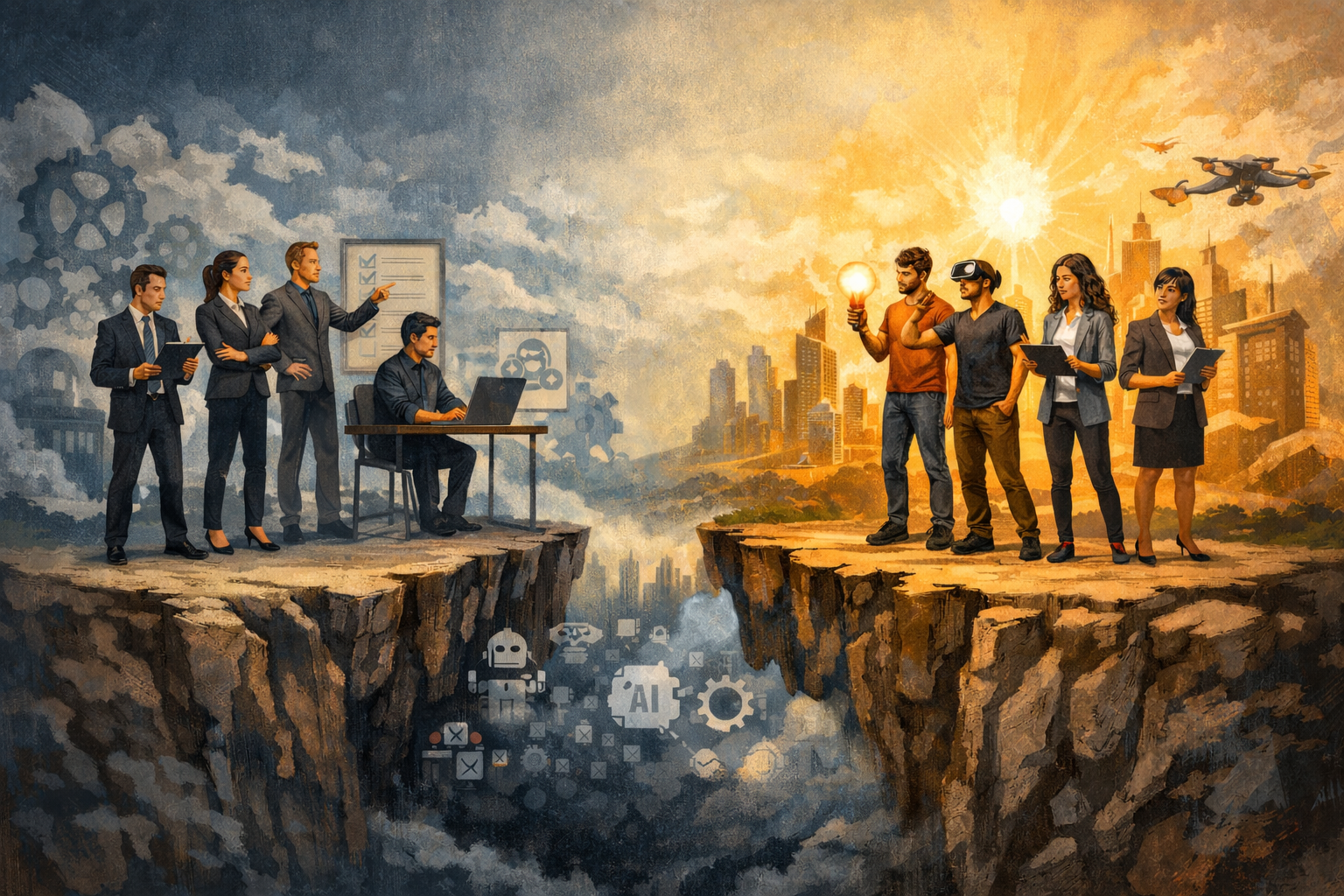

The missing discipline in change management, and why the field itself is incomplete.
You could see it before anyone said a word.
NBC on one side of the table. Universal on the other. The swag said it all: coffee cups, branded notepads, each carrying the old logo. Six months into a merger that had already been declared complete on every dashboard, they were still two tribes in a negotiation that hadn't ended.
I was there on the systems integration side. By every metric available to the program, things were on track. Org charts redrawn. Due diligence complete. Event the culture box had its checkmark. Systems integrating.
But the room showed something different.
We and you. Us and them. The language of people who had not yet become one company, however the org chart described them. And not just in the words, in the posture. In the physical act of sitting on opposite sides of a table.
The structure said: one company.
The interior said: two tribes.
That gap was invisible to every dashboard, every project tracker, every executive update. And it was the only thing in the room that actually mattered.
That day, twenty years ago, I stopped pretending the two halves of my work were unrelated. Enterprise strategy during the day. Art, philosophy, psychology, interior work in the evenings. The split wasn't in me. It was in the environment. And I keep seeing the same split in my clients now: performing in systems by day, living a human life on the evenings and weekends.
Systemic transformation is always also human transformation.
So why does the field keep treating them as two different jobs?
The Problem Isn't the Strategy
Most transformations don't fail dramatically. There is no board-level crisis, no visible collapse.
They fail slowly, invisibly, as the new strategy gets absorbed back into old patterns. The decks get filed. The pilots get abandoned. The language changes. And little else really does.
BCG's analysis of over 850 companies found that only 35% of digital transformations reach their stated goals. McKinsey puts it at roughly 30%. Bain's 2024 research suggests 88% fail to achieve their original ambitions. And across these studies, approximately 70% of failures trace back not to technology or strategy. They trace back to people and culture.
Let that sink in.
You already know this. You've probably cited it in a steering committee.
The question nobody seems to be asking (or perhaps avoiding, since the big consulting firms profit from selling the same playbook yet again): why does the field keep producing the same results, year after year, with ever more sophisticated methodology?
The answer is that the map is incomplete.
Most change management helps people understand, accept, and implement change. That matters. But transformation asks for more than acceptance. It asks people to operate from a larger identity, under greater ambiguity, in relationships and systems that no longer behave as before. That is not a communication problem or a skills problem alone. It is a developmental demand. And when that demand is ignored, transformation may launch, but it does not stick.
Transformation rewrites the rules people have built their identity around. The role they thought they were good at. The relationships they trusted. The rhythms that made them feel competent. When that ground moves, the body moves first. Reactivity. Compliance theater. Retreat into the old role. Quiet refusal disguised as cooperation.
Communication and training create awareness. They do not create capacity. Development does. It builds the ability to stay present, make meaning differently, experiment in real time, and sustain new ways of operating when the pressure rises. This is why human development is what allows change to stick.
How We Got Here
These tools were built for a different era. And for their era, they were brilliant.
John Kotter's Leading Change came out of Harvard in 1996, built on case studies from the 1980s. Prosci's ADKAR emerged in the mid-1990s. McKinsey's 7S framework goes back even further. All were designed for a world with a somewhat knowable future, a clear end state, and enough time to execute a planned sequence.
The toolkit fit the problem: communicate the vision, provide training, reinforce new behaviors, anchor the change in culture. Complicated, in the Cynefin sense. The work could be mapped and managed once you understood it well enough.
We are no longer in the complicated era. We are in complex. The system itself shifts as you act on it. The transformations you are leading today don't have clear end states. The technology shifts while you are writing the roadmap. Multiple transformations run simultaneously. And the people you are asking to change are exhausted by change and doing so without the psychological safety of stable ground beneath them.
The field grew up solving a different problem. It has not yet caught up to ours. Not a failure of the discipline. A gap created by the acceleration of time.
The maps are not wrong. They are incomplete. And so is every transformation strategy still navigating by the same toolkit. Because the field itself is incomplete.
These models do address the human side. They treat it as adoption, alignment, communication, reinforcement, behavior change. What they were not built to produce is vertical development, embodied responses to uncertainty, or the relational conditions adult transformation requires. Those take sustained reflective practice, social learning, and relational safety. The toolkit was designed for a different problem.

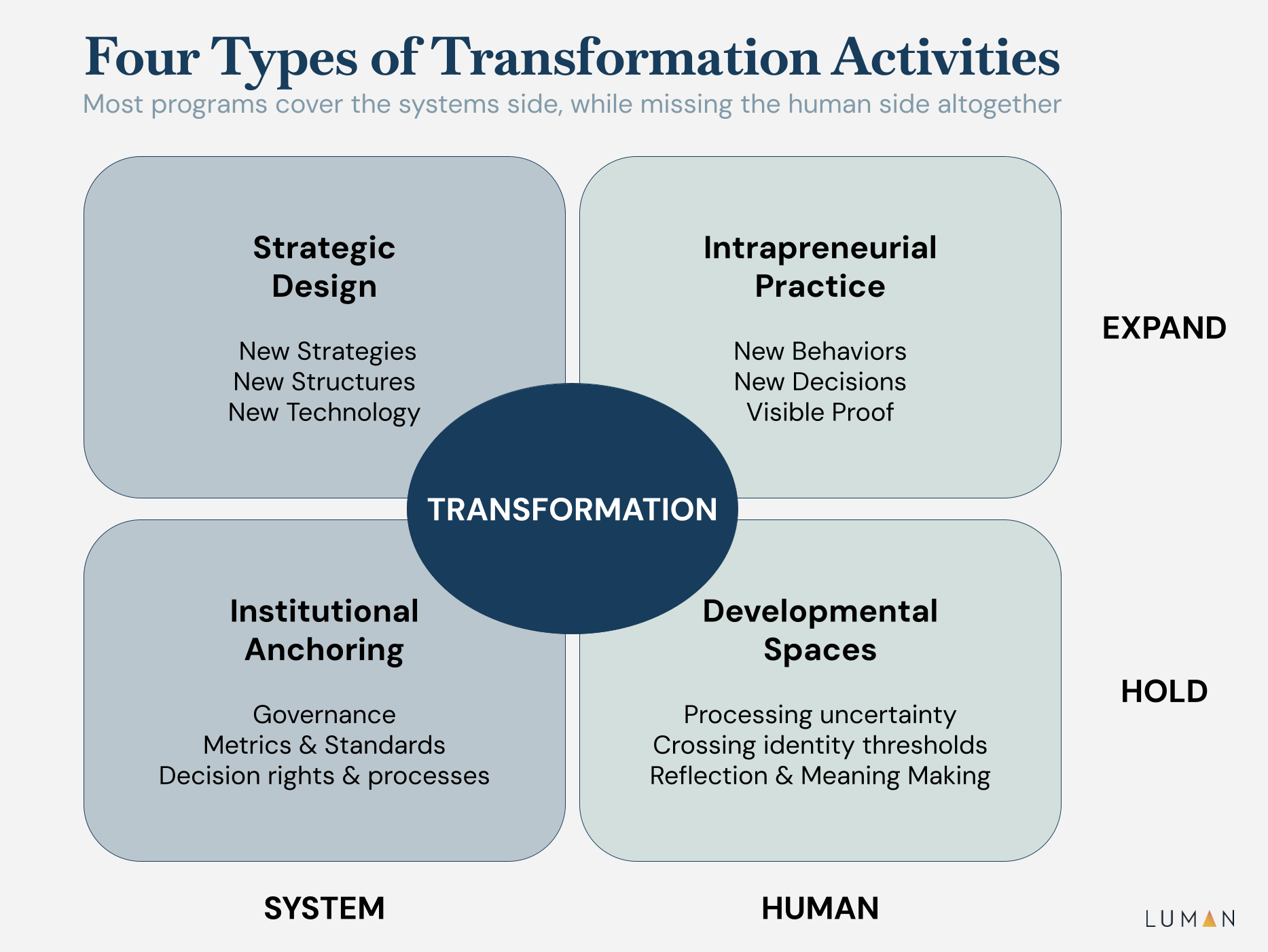
The Map Most Transformations Are Working From
Every transformation requires work along two dimensions:
- The first dimension is where the work is aimed: at the System or at the Human. System work targets the organization: its structures, processes, technology, governance, culture as a set of shared agreements. Human work targets the people: their identity, development, behavior, and capacity to grow into what the transformation actually demands of them.
- The second dimension is what kind of work is being done: Expanding into the new, or Holding what is emerging. Expanding means pushing the frontier: creating new direction, new strategy, new behaviors, new possibilities. Holding means creating the container: sustaining integrity, anchoring meaning, building the ground that allows expansion to take root.
Those two dimensions then produce four types of work. And every transformation needs all four.
- System + Expand: new strategies, operating models, technology stacks, structural redesigns
- System + Hold: governance, metrics, decision rights, compliance, incentives, budgeting
- Human + Expand: prototyping and experimentation, stretch roles, cross-boundary collaborations
- Human + Hold: developmental spaces, coaching, peer reflection, conflict processing, meaning-making, identity transition support
Most programs invest heavily in System work, both expanding (new strategies, new structures, new technology) and holding (governance, compliance, standards, process). That side of the map is well-covered. Often very well-covered.
The Human side is where the map goes blank. The expanding work with people: prototyping new behaviors, making new decisions, creating visible proof that a different way of operating is actually possible, is funded sporadically if at all. And the holding work with people: creating sustained developmental space where individuals can process uncertainty, cross identity thresholds, and grow into a genuinely new sense of self. This work is almost never on the program budget.
This is not a people problem. It's a map problem.
The field built much of its methodology around system design, rollout, and adoption, then often treated that as complete. ADKAR, Kotter, Prosci are all brilliant tools (I have used them myself for years), but they are mostly aimed at the system and a functional, not developmental, view of humans. They were not designed to develop the human. That doesn’t make them wrong. It reveals a limitation in what the field has historically prioritized.
Who Is in the Room, and Who Isn't
The fastest way to diagnose your transformation is to look at who you have assembled to lead it.
Transformations require four types of catalysts. But typically, organizations only deploy two:
- Navigators expand the system. They are your strategists: the ones who map the journey, align leadership, build decision frameworks, and ensure the transformation doesn't descend into chaos. Most programs have Navigators. They're often running the program.
- Stewards hold the system. They anchor change into the organization's actual fabric: ensuring new ways of working embed in metrics, standards, shared values and practice. Stewards don't just enforce governance. They hold the institutional memory of what the organization is becoming.
- Intrapreneurs expand the human. They are the behavioral experimenters: the ones who prototype new ways of working, make new decisions, and create visible proof that a different way of operating is actually possible. Without Intrapreneurs, behavioral change stays theoretical. Someone has to be the prototype of new behaviors (which then inspires others).
- Guides hold the human. They hold the developmental and emotional space that transformation requires. They create the conditions for people to process uncertainty, cross identity thresholds, and grow into a genuinely new sense of self. They understand that resistance to change is rarely rational. It is all too often existential.
Now look at your transformation team.
How many Navigators? How many Stewards?
How many Guides? How many Intrapreneurs?
In most programs, the first two are well-represented. (And culture is often treated as a thing: a communication campaign or two should do the trick, right?)
The second two are absent, or survive only informally, in the exceptional leader who cares about people despite the culture, in the maverick who experiments around the edges rather than through the center.
System side: covered. Human side: mostly empty. Half the map. And we are surprised when half the results arrive.
Where the Map Goes Blank
The Guide's domain is where most transformation programs have the least investment and the greatest need.
This is the domain of development. Not training. Not upskilling. Not learning a new tool. Development. From the Old French développer: to unfold, to unwrap. The slow process by which a person comes to see themselves differently, to hold more complexity, to act from a deeper and more resilient center.
As I explored in The Capability Gap: the distance between what an organization is trying to become and what its people are currently capable of being is not a skills problem. It is a vertical development problem. Training is horizontal: it adds new skills to the same person. Development is vertical: it expands who that person is in relation to their work.
And it goes all the way down to the individual level.
When people are treated as functions in an org chart (roles to be retrained, not human beings to be developed) only one dimension of their humanity is engaged. The rational part. The capacity for information processing and skill acquisition.
But human beings are not primarily rational. We have bodies that carry the physical tension of uncertainty. We have nervous systems that respond to ambiguity with stress and reactivity. We have relational fields that determine whether we trust the people sitting across the table from us. We have a need for meaning, not just for instruction.
Ignore those dimensions and you produce exactly what most transformation programs produce: people who might be able to recite the new strategy, but continue behaving in the old ways. People who, six months into a merger, still reach for the coffee cup with the old company's logo.
Why the Interior Is So Hard to Reach
Look at what actually happens in a human nervous system in the liminal space of transformation.
Uncertainty and ambiguity trigger the amygdala, the part in our brain looking out for danger. This activates the sympathetic nervous system. Cortisol rises. Attention narrows, along with the cognitive capacity needed for reflection, integration, and flexible response.
No wonder many communications don’t land.
You can deliver the most beautiful townhall you have ever designed. But if the room is full of people whose nervous systems are quietly screaming, your efforts will be in vain. They will nod. They might clap. They might even rate the session favorably (while making anonymous comments in the chat). But nothing will move. Because information rarely integrates when the body is in a protective state.
New behaviors get learned through co-regulation, not just through instruction. The nervous system learns safety from other nervous systems. Psychological safety and relational context are required for integration. Instruction matters, but new behaviors are far more likely to take root when people experience sufficient safety, reinforcement, and social modeling. This is also why the Guides in your organization matter more than your training decks.
And developmental change, the vertical move that actually shifts who people are, requires something the standard toolkit was not built to create: a sustained container of safety in which identity can be examined, loosened, and re-authored. That is not happening in a one time event. That takes practice.
Insight alone rarely shifts a nervous system state. You cannot communicate your way into one that is protected against you. And you cannot roadmap your way into a new identity.
The current transformation toolkit is incomplete. It is missing the layer where humans actually live.
Transformation sticks when organizational design, social context, and individual development reinforce one another. Most programs invest in the first and underinvest in the latter two.
What Developmental Change Actually Looks Like
Human development is a broad category. It does not mean generic soft-skills training. In the context of organizational transformation, it means expanding people’s capacity to handle complexity, uncertainty, conflict, feedback, customer proximity, cross-functional collaboration, identity shift, and new forms of agency. It involves changes in how people make meaning, not only in what they know.
We worked with Siemens over the last decade on their Intrapreneurs Bootcamp. What made it different (and what made it a “zero regret” investment for them) is that they realized early on it's not just about methods and tools.
The methods and tools were the anchor. Over 14 weeks we moved people through the typical innovation toolkit: topic and stakeholder maps, persona profiles, value proposition design, business model canvas, prototyping, testing, pitching. But Siemens also understood the human dimension.
Alongside the project and ecosystem tracks, the program had a designated people track. That's where we turned employees into intrapreneurs. The developmental work that gave participants a new sense of self and identity.
A quarter long. Weekly cadence. Sessions on authenticity, psychological safety, agreements, feedback, care, even purpose. We held space for them to ease into new behaviors inside a safe container. Through spaced repetition and a curriculum that built on itself, new ways of being became habitual.
Most of them met with customers for the first time in their lives. Even seasoned engineers, decades into their careers. Normally, engineers do not call customers. That is usually seen as the domain of sales (or of customer support after things have gone wrong). For the identity of an engineer, it was not an available action.
But they picked up the phone. They called. They interviewed. With preparation, with account reps in the loop where it made sense. Still: a bit of a rogue action for “normal” corporate employees.
For many of them, this simple act was life-changing.
And for many, for the first time at work, they were seen as whole humans, not just job functions.
I loved the moment when an engineer came up to me and said: “You know, I knew I was very good at thinking. You have shown me: I am good at feeling, too.”
That is not a new skill. That is a developmental shift that only became available because of a new identity.
Behavior change is the visible surface. Development is the deeper shift in meaning-making, identity, and capacity that makes those behaviors durable under pressure.
Engineers initiating customer conversations. Teams working across silos. People learning to tolerate ambiguity rather than escalating or jumping to premature solutions. Conflict engaged directly rather than routed through politics. The difficult conversations actually happening. All of that was the outcome as participants moved from employee compliance to intrapreneurial authorship.
Multiply that by a hundred. Then by a thousand. Across multiple cohorts, over several years, participants moved into roles with greater responsibility. They started initiatives that did not exist in the org chart. Some of them became Guides and Intrapreneurs of their business units, carrying the new behaviors into meetings that no training program had reached.
This is developmental change. It is personal, human, and not easily captured by a dashboard. It produces ripples across the organization. An internal study showed that on average, each bootcamp participant influenced about 10 colleagues in their home department to adopt these new behaviors. This outlasted everything else in the program, because it changed who the people were, not just what they knew.
The work that makes transformation stick is almost never the work that shows up first on the steering committee report. It is the work happening in hallways, in one-to-one conversations, in the rewiring of identity.
I am done with great things and big plans, great institutions and big success. I am for those tiny, invisible loving human forces that work from individual to individual, creeping through the crannies of the world like so many rootlets, or like the capillaries. — William James, The Will to Believe
That is the level at which transformation actually moves.
Done carelessly, this kind of identity-level work can also be manipulative or destabilizing. That is precisely why it must be approached consciously and responsibly.
There is an organizational dimension here too. An organization optimized for its current business model will experience this work as friction, or dismiss it as “soft skills” reserved for when there is some extra budget to burn (meaning pretty much never). But an organization learning to operate as a continuously adapting system will recognize it as the key to making transformation stick.
The question of whether your company treats developmental work as cost or as capability is the question of which kind of organization you are becoming.
If you look at your current portfolio and cannot point to where that work is happening intentionally, with real investment, you have located the gap.
Three Invitations Before Your Next Conversation
Allow yourself this genuine inquiry.
Map both dimensions honestly. Look at your transformation portfolio against the two axes: System and Human, Expand and Hold. Where is your actual investment? Be specific. A communication campaign is not human work. A training program is not behavioral development. Locate the blank spaces on your own map. They will tell you more than the populated ones.
Name the specific people doing Guide and Intrapreneur work. Not in theory. In practice, with names. Who is genuinely holding developmental space for people navigating uncertainty and fear? Who is actually experimenting with new behaviors, visibly, so others can follow? If you cannot answer with names, you do not yet have a transformation. You have a project plan.
Notice what your culture says about the interior. Is identity work, embodied development, the emotional dimension of transformation treated as legitimate business investment? Or as something that happens on personal time, funded when there is surplus? The culture's answer to that question is its real answer to transformation.
Sit with those three. The answers will tell you more about your transformation's actual trajectory than any steering committee report.
You're Not Failing. You Have Half a Map.
Leaders who are carrying the private weight of a transformation that looks good on paper but feels hollow in practice are not doing anything wrong.
They are navigating with an incomplete instrument.
The exterior work is real and necessary. The strategy. The systems. The governance. But on its own, it is incomplete.
You get to build the other half.
Transformation has stuck when new behaviors persist under pressure, spread socially beyond the pilot group, survive leadership attention cycles, and become part of how people actually make decisions together, especially under uncertainty.
What the NBC Universal room clarified for me back then is that the program succeeded at everything it was designed to do. It integrated the exterior. But it left the interior untouched.
And the interior is where people live.
The exterior and the interior are not two separate programs. They are two halves of one transformation. Complete the map. Complete the work.
If this map has named something you have been carrying privately: the gap between what looks good on the slides and what you feel in the room, then that recognition is already beginning.
The next step is completing the design.